
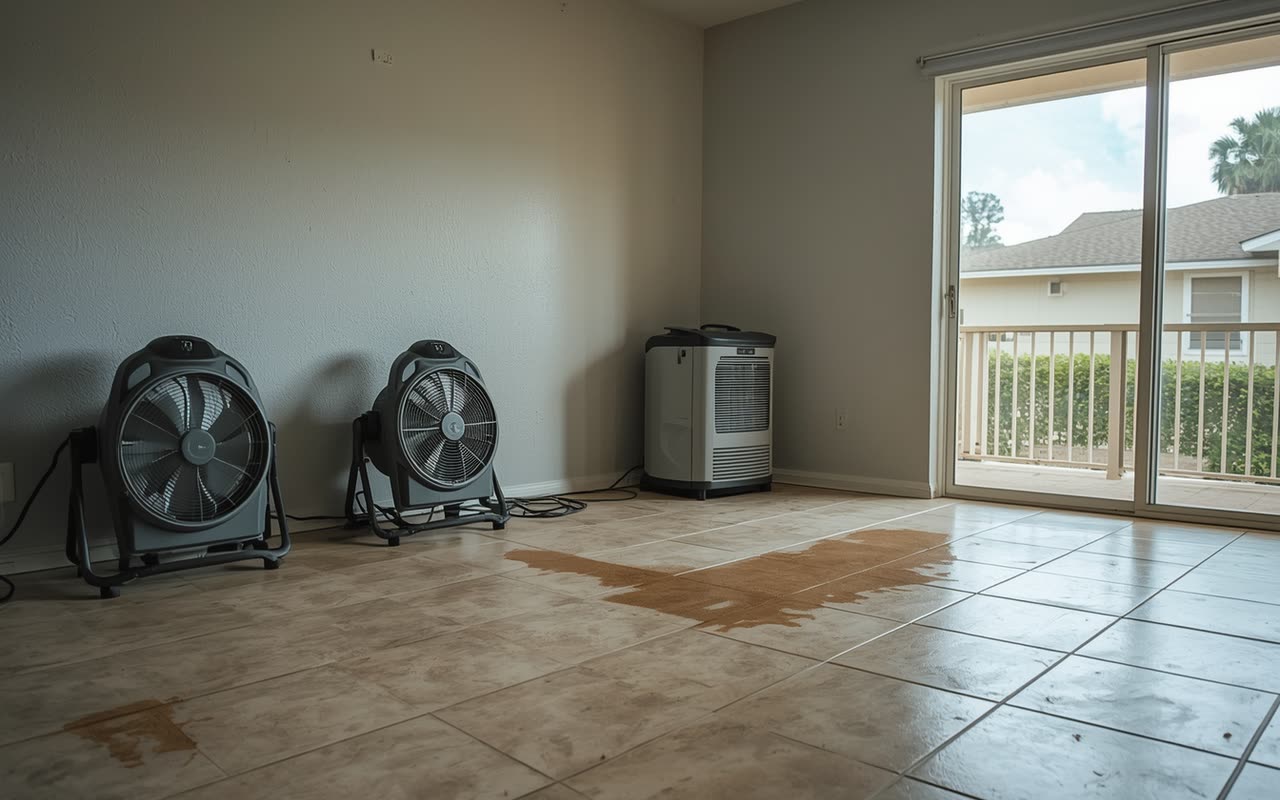
Water damage in a Tampa Bay home is a race against a very specific clock. The air here is warm and wet for most of the year, so a soaked wall does not sit quietly. It starts to feed mold within a day or two, the baseboards swell, the paint bubbles, and the smell that shows up on day three is usually already telling you something has been growing behind the surface.
Water damage restoration is the whole job of getting a building from wet back to dry, and then back to normal. It starts with stopping the water and removing what is standing. It continues with the part most people never see, which is drying the structure itself: the studs, the bottom of the walls, the subfloor, the slab and the air. It ends, when needed, with rebuilding what had to come out. This page walks through all of it in plain words, so you know what a proper job looks like when someone is standing in your living room with a moisture meter.
What counts as water damage
Any time water ends up where it is not supposed to be and stays there long enough to soak into building materials, you have water damage. The source matters, because it decides how the job is handled. In the Tampa area the usual sources are:
- A burst or leaking supply line, a failed water heater, a washing machine hose or an ice maker line.
- A clogged AC condensate drain that overflows into a closet, ceiling or wall.
- A roof leak after a summer thunderstorm, often around tile roof flashing, vents or skylights.
- A toilet, tub or shower that overflows or leaks slowly into the floor below.
- A sewer or drain backup, which brings a different kind of water into the house.
- Storm surge or rising river and canal water, which is a flood loss and has its own page: see flood damage restoration.
Most of the homes here sit on a concrete slab. That detail changes what water does. In a two-story house, water from upstairs travels down through the ceiling, into the wall cavities and onto the floor below. In a single-story slab house, water cannot go down, so it spreads sideways across the floor, wicks up into the bottom few inches of the drywall and runs under baseboards and into cabinet bases. A thin film of water on a large floor can wet far more of the house than it looks like.
The three water categories, in plain words
The industry standard, ANSI/IICRC S500, sorts water by how contaminated it is when it arrives. You will hear these called categories 1, 2 and 3. They matter because they decide what can be dried in place and what has to be thrown out.
Category 1 is water from a supply line. It comes from a pipe, a faucet, a water heater or a supply hose, and it is not carrying contamination when it first lands. This is the strongest case for saving materials, but it does not stay that way. Water that sits on a floor, soaks into carpet and picks up dust, soil and bacteria can slip into category 2 within a day or so, and warm Florida temperatures speed that along. Speed is the difference between drying a wet floor and replacing it.
Category 2 is water with some contamination. Think of a washing machine or dishwasher discharge, an overflowing sink with soap and food residue, a toilet overflow with urine only, or supply-line water that has been sitting for a while. It can make people sick if swallowed or if it gets into a cut. Hard surfaces can usually be dried and treated. Porous materials such as carpet padding and soft insulation generally have to come out.
Category 3 is grossly contaminated water. Sewage, floodwater from the bay or a river, water from a rising canal, and anything that has been in contact with the ground outside the house. It carries bacteria and other organisms that can cause serious illness. Porous materials that this water touched are removed, not dried, and the work is done with protective gear. If you have any doubt about the source, treat it as category 3 until a specialist says otherwise. Do not wade through it barefoot, and keep children and pets out.
One more point that surprises people: a category 1 loss that is not dried in time becomes a mold job. We will come back to that, because in Florida it is the most common way a small plumbing leak turns into a large repair.
The four drying classes
Separate from the category of water is the class of the loss, which describes how much and what kind of material got wet. S500 defines classes 1 to 4:
- Class 1: a small area, with little wet material and low-porosity surfaces. A single wall section or a small area of floor.
- Class 2: a larger area, wet carpet and padding, with moisture wicking up the walls less than about 24 inches.
- Class 3: water that came from above, such as a roof leak or an upstairs supply line, so that ceilings, walls, insulation and floors are all wet. Evaporation demand is highest here.
- Class 4: specialty drying, where deeply bound water sits in dense materials such as hardwood, plaster, concrete and the slab. These take longer and need different equipment.
The class helps set the equipment plan: how many air movers, how much dehumidification capacity and how long the job is likely to run. It is not something you need to memorize. What you need to know is that a competent specialist can tell you, in a sentence or two, which class your loss is and why.
What extraction means
Extraction is removing the bulk liquid. If there is standing water, it comes first, because no amount of drying equipment is efficient while an inch of water sits on the floor. Depending on the amount, that can mean submersible pumps, truck-mounted or portable extractors, wet vacuums and weighted extraction wands that pull water out of carpet and padding. In a house with wall-to-wall carpet, extraction can recover a large share of the water before any drying equipment is turned on, which shortens the whole job. If you want the detail on what happens in the first hours, see emergency water removal.
A mop, a towel and a household vacuum do not substitute for extraction. Towels cannot pull water out of padding. A household vacuum is not built for water and can be a shock hazard. And on a slab, water that is pushed around with a mop simply goes into the base of the walls.
Structural drying: how the building actually gets dry
This is the heart of restoration, and it is the part that quick fixes skip. Drying a building is not the same as drying a towel. Water moves into dense materials slowly and has to be coaxed back out as vapor. The process uses four tools working together.
Air movers. These are the small, loud fans you see in the room. They do not dry the air. They move a thin layer of air across wet surfaces so that water evaporates from them faster. They are aimed at floors, along wall bases and sometimes into wall cavities through small holes or openings made for that purpose.
Dehumidifiers. These are the machines that take the water out of the air once it has evaporated. Without them, the water just goes into the air and then back into the next material. The size and number depend on the volume of the space and the class of the loss.
Moisture mapping. Before and during the dry-out, the technician uses a moisture meter, often a thermal camera and a hygrometer to find where the water is, including places you cannot see. A thermal camera shows cooler areas that suggest evaporation, and a meter confirms them. The result is a map of the loss. The map is why the equipment goes where it does, and why a wall that looks dry may still get a hole cut in it.
Daily readings. A real dry-out is monitored. The technician returns each day, takes moisture readings in the same spots, records temperature and humidity inside and outside, and moves or removes equipment as areas dry. If the readings are not falling, something is wrong, and the plan changes.
Drying goals and the dry reference
How do you know when it is done? You do not guess by touch. The goal is set against a dry reference: a reading taken from the same type of material in an unaffected part of your own house. If the drywall in your hallway reads a certain moisture level, that is the target for the wet drywall in the bedroom. Materials are considered dry when they get back to that reference range. The same idea applies to wood framing, subfloor and flooring. Without a reference, a reading is just a number.
Ask whoever does the work to show you the readings at the start and at the end. A clear record of falling numbers is the simplest proof that the building is dry. It is also useful paperwork for your insurer, which we will get to below.
Why Florida humidity changes the whole plan
If you have read general advice that says "open the windows and run fans," you can set it aside here. In much of the country that works because the outdoor air is drier than the indoor air. In Tampa, for a large part of the year the outdoor air is as humid as, or more humid than, the air in the damp room. Bringing it inside adds moisture instead of removing it.
For that reason, a proper dry-out in this area is done with a closed building. Doors and windows stay shut. Dehumidification does most of the moisture removal, and air conditioning is usually left running at a moderate setting so the air can hold and release moisture in a controlled way. Heat helps evaporation, and in a warm house that is a benefit, but only if the humid air is being pulled out of the building as fast as it is created.
Two local details are worth knowing:
- Rainy season. From roughly June through September, near-daily afternoon storms keep outdoor humidity high. A dry-out that starts in July has a harder job than one in February, and the equipment plan should reflect that.
- Short-cycling AC units. An oversized air conditioner cools the house quickly and shuts off before it has removed much moisture. If yours does that, the house can feel cool and still be damp, which is exactly the condition mold likes. A dry-out in that house leans more heavily on dedicated dehumidifiers.
If you have a leak and the house has been closed up for a while, such as a seasonal home with the AC set high, the problem compounds. The air is already damp, the surfaces are cool and the materials are wet. Mold can come in fast. See humidity and mold in Florida homes for the longer explanation.
What can be saved and what must come out
This is the question every homeowner asks, and the honest answer is that it depends on the type of water, how long the material was wet, and what the material is. Here is how the usual building components are generally treated.
Drywall. If it was wet with category 1 water for a short time, it can often be dried in place, especially when it has a hard surface and is not sagging or soft. Drywall that has been wet for more than a day or two, has gone soft, is crumbling or is stained and swollen is usually removed. Drywall that touched category 2 or 3 water is removed. When a wall is cut, a "flood cut" removes the drywall up to a line above the highest wet reading, typically a foot or two above the floor, so that the cavity can be inspected and dried.
Insulation. Fiberglass batts that got wet from a supply line can sometimes be dried, but wet insulation holds water against the framing and is often removed so that the cavity can dry properly. Blown-in insulation in an attic that has gotten wet from a roof leak is usually removed where it has clumped or stayed wet. Any insulation exposed to category 3 water is removed.
Baseboards and trim. Painted wood or MDF baseboards that have swollen or are lifting from the wall generally come off. Often they are removed early in the process, even if they could be saved, because pulling them lets the bottom of the wall dry.
Carpet and padding. Padding that is wet almost always comes out. It soaks up water like a sponge and is cheap to replace compared with the cost of drying it. Carpet from a category 1 loss can sometimes be dried in place, lifted and re-stretched. Carpet from category 2 or 3 water is generally removed.
Cabinets. Solid wood and plywood cabinet boxes can often be dried, particularly after a toe-kick is removed. Particleboard and MDF boxes swell when wet and often do not recover. The area behind and under cabinets is a hidden spot where mold starts, so it needs to be opened and read.
Hardwood and engineered flooring. These can sometimes be dried with specialty mats and drying systems when the loss is caught quickly. They can also cup, buckle and warp even after they dry, so the decision may need to wait for the readings to settle. Laminate and engineered products that have swollen at the edges generally do not recover.
Tile. Ceramic tile itself is not harmed by water, but the substrate and the mortar bed underneath can hold moisture. A tile floor over a slab is usually fine; a tile floor over a wood subfloor needs a closer look.
Subfloor. Plywood subfloors can often be dried in place with appropriate equipment. If the plywood has delaminated or has been wet long enough to grow mold, sections are removed.
Slab. Concrete does not get destroyed by water, but it holds moisture for a long time and releases it slowly. That moisture matters when new flooring goes down. A slab that has not been checked can later cause flooring to fail or mold to grow underneath it. The slab is part of the drying plan, not an afterthought.
None of these calls should be made by guessing. A good specialist explains each decision with a reading or a visible reason, and it is fair to ask why something is coming out. If you want to understand the line between small and large problems on the mold side, see mold removal.
How long it takes
A typical dry-out takes several days. For a small loss that is caught fast it may be shorter, and for a larger one, or one involving dense materials like hardwood, plaster or a saturated slab, it can run longer. A loss that is complicated by humid weather, hidden moisture behind cabinets or insulation that was wet for a while can stretch the timeline. Anyone who promises an exact finish date before they have seen the readings is guessing.
What the timeline usually looks like:
- Day one: stop the source, extract standing water, map the moisture, remove what clearly has to go, set the drying equipment.
- Days two through the middle of the job: daily readings, equipment adjusted, more material opened if the readings show water in places that were not obvious.
- The end of the dry-out: readings match the dry reference, equipment is pulled out, and the house is ready for repair decisions.
Rebuilding is a separate stretch of time, covered below.
Documenting the loss for your insurer
If you plan to file a claim, the paperwork is your friend. Nobody can promise what a policy will pay. What a restoration company can do is keep the kind of records that make your conversation with the adjuster easier. Those records are also what you should ask for.
- Photos and video of the damage before anything is moved or removed, including the source, the water line on walls and furniture, and each affected room.
- A moisture map and daily logs showing the readings, the equipment placed and the dates.
- A list of materials removed, with a note on why, such as "category 2 water" or "swollen and soft."
- An itemized scope that lists what was done and what remains to be repaired.
Take your own photos too, and keep damaged items that the adjuster may want to see until you have been told you can dispose of them. Read your policy for the claim reporting deadline, the water damage language and any exclusions. Many policies treat sudden and accidental discharge differently from long-term seepage, and many cap or limit mold coverage, so it is worth reading yours before you decide how to proceed. Your insurer decides what is covered. The restoration company documents what happened and what was done.
Water damage and mold: the 24 to 48 hour window
In Florida's climate, wet building materials can start to grow mold in about 24 to 48 hours. That is not an exact timer, and it depends on the material, the temperature and how much moisture is present. It is a good working rule, and it is the reason a call made on the day of the leak tends to cost less and save more than a call made on day four.
Signs that water damage has already turned into a mold problem:
- A musty smell that gets stronger when the AC kicks on.
- Dark, fuzzy or speckled patches on the lower part of a wall, the back of a closet or the underside of cabinets.
- Paint that is bubbling, peeling or staining in rings.
- Drywall that feels soft, powdery or damp even though the leak "stopped" days ago.
- Allergy-like symptoms, such as sneezing, a stuffy nose or irritated eyes, that ease when you leave the house.
If you see mold after a leak, that does not mean a disaster. It does mean the job now has two parts: dry the structure and deal with the mold. The EPA's guidance is that a patch of mold under about 10 square feet on a hard surface can often be handled by the homeowner, using an N95 respirator, gloves and eye protection, and by fixing the moisture source first. Bigger areas, mold on porous materials like drywall and insulation, or mold in HVAC components call for a professional. That is the work covered on our mold removal page.
When it is a mold job as well as a water job
Not every water loss becomes mold. When a leak is caught within a day and dried properly, the readings come back to normal, and nothing else happens. When it goes longer, or when hidden spots stay wet, mold can follow. A few situations where you should assume mold is part of the project:
- The water has been present for more than two or three days, especially in a closed-up house.
- You find a musty smell or visible growth in a wall, ceiling or cabinet that was wet.
- The affected area is larger than a small patch, or includes drywall, insulation or ceiling material.
- The loss involved category 2 or 3 water that sat for a while.
- A previous leak was "fixed" but the wall never got opened and read.
In those cases, a moisture and mold inspection is a good next step. That is a visual inspection with moisture readings, thermal imaging and humidity checks, and it tells you where moisture is, whether it is still active and what likely needs to be removed. See mold inspection for how that works. The goal is to find and fix the water, remove what has mold on it, and dry the rest so it does not return.
The rebuild step
Restoration does not end when the equipment goes away. Once the structure is dry and everything that had to be removed is out, the house needs to be put back. That is the rebuild: new drywall hung, taped, textured and painted, new insulation if it was removed, baseboards and trim reinstalled, flooring replaced, cabinets repaired or reset.
A few points that matter in this part of the work:
- Match. Wall texture, paint sheen and flooring are hard to match between old and new areas. Talk about it before the work begins, not after.
- Timing. New materials should not be installed until readings show the structure is dry. Closing up a wet wall is how mold comes back.
- Permits. Depending on the extent of the work, some repairs may need a permit from your city or county building department. Ask them or ask the contractor how it is handled.
- Substantial damage. In flood-prone areas, local rules can treat a repair as "substantial damage" when its cost reaches about half the value of the building, which triggers additional requirements. If your loss is large, ask your city or county building department how it applies to your address.
Many people prefer one team to handle the drying and the rebuild so that nobody has to explain the previous step to the next one. Others use their own contractor for the repair. Either is fine, and a good restoration company shares the scope and readings with whoever does the rebuild.
How to tell a proper job from a quick one
A few questions separate a thorough dry-out from a fast one that comes back later:
- Did they take moisture readings in more than one place, and write them down?
- Did they explain what category and class of water they believe it is, and why?
- Are they using dehumidifiers and keeping the building closed, rather than just fans and open windows?
- Will they come back and read again the next day, and the day after?
- Did they tell you what will be removed and why before cutting anything?
- Did they set a drying goal against a dry reference?
- Do you get a written record at the end?
If any of those answers is vague, keep asking. You are about to hand someone your house for several days.
What to do right now if the water is still there
If you are reading this while water is still on the floor, here is the short list:
- Stop the source if you can. Shut off the water at the main, or at the fixture's shutoff valve.
- If water is near outlets, appliances or the electrical panel, leave the power alone and stay out of the room. Call an electrician if you must shut off the main breaker and the panel is wet.
- Move small valuables and papers to dry ground.
- Take photos before moving things.
- Call a water damage specialist. Water does not wait for business hours, so call as soon as you see it.
The longer guide is in the first 24 hours after water damage, and the first-hour details are on our emergency water removal page.
Questions people ask
How do I know if my water damage is category 1, 2 or 3?
The source is the starting point. Water from a supply line, a faucet or a water heater begins as category 1. Water from a washing machine, a dishwasher or a toilet with urine only is generally category 2. Sewage, floodwater and water from outside the house is category 3. Time matters too: category 1 water that sits for a day or more, especially in a warm house, can degrade. A specialist reads the situation from the source, the length of time and the condition of the materials. If you are unsure, do not touch the water with bare skin and treat it as contaminated until someone looks.
Can I just open the windows and run fans to dry things out?
In much of the Tampa Bay area, that usually does not work well. Outdoor air here is often as humid as the indoor air, so opening windows brings in more moisture. A proper dry-out uses a closed building with dehumidifiers and air movers, and typically the air conditioning running. For a small spill on a hard floor, towels and a fan are fine. For anything that has soaked into drywall, padding or cabinets, you need more than that.
How long does water damage take to dry?
A typical dry-out takes several days, though a small loss caught early may be quicker and a large or complicated one may take longer. Dense materials like hardwood, plaster and concrete dry slowly. The end of the job is set by moisture readings reaching the dry reference, not by a number of days. Beware of anyone who gives you a firm finish date before looking at the readings.
Will my insurance cover water damage?
That depends on your policy and on the cause. Many homeowner policies cover sudden and accidental water damage, such as a burst pipe, and exclude long-term leaks, seepage and flood. Standard homeowner policies generally do not cover flood from rising water; that requires separate flood coverage through the NFIP or a private insurer. Many policies also cap or limit mold coverage. Read your policy and call your insurer promptly. A restoration company can document the loss with photos, readings and a scope of work, but your insurer makes the coverage decision.
Do I have to throw away everything that got wet?
No. Hard, non-porous items, solid wood furniture, many dishes and most items made of metal or glass can usually be dried and used again if the water was from a supply line. Porous items such as mattresses, upholstered furniture and carpet padding are more likely to go, especially if the water was category 2 or 3. Papers and photos can sometimes be dried quickly, so move them to a dry place and photograph them before deciding. Take pictures of anything you discard in case your insurer asks.
How soon does mold start after a leak?
Often within 24 to 48 hours in warm, humid conditions, though it varies. That is why the early hours matter so much in Florida. If the area stayed wet for several days, plan on checking for mold even if you cannot see it. Look behind baseboards, inside cabinets and at the lower part of drywall. See our mold removal page if you find growth.
Do I need to leave the house during a dry-out?
Not always. For a small category 1 loss in one area, many people stay. The equipment is loud and runs continuously, and the house will feel warm and dry. For category 3 water, large areas or any mold work, it is safer to stay elsewhere until the contaminated material is out. People with asthma, young children, older adults and anyone with a weakened immune system should be cautious.