
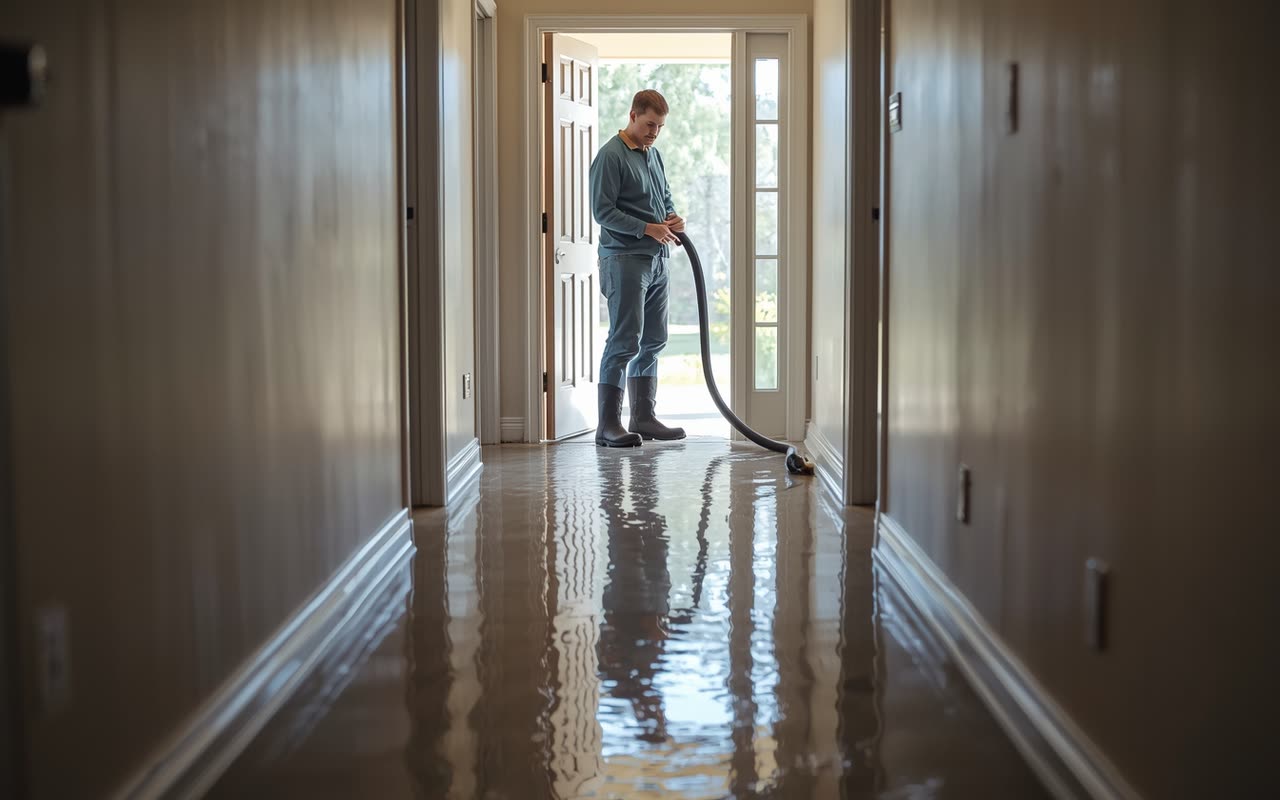
You are standing in an inch of water, or you just came home to a ceiling on the floor, and your head is full of questions. Is it safe to walk in here? Where does the water go? Can I just mop it up? Who do I call, and what do I tell them?
This page is written for that moment. It goes through what to do in the first hour, what happens in the first day, how a crew removes standing water from a Florida slab house, and what you can safely do on your own while you wait. Water does not wait for business hours, so if you can read this on your phone while you act, do that.
The first few minutes: safety before anything else
Wet houses are dangerous in ways that are easy to miss when you are upset and in a hurry. Run through these four things before you worry about the furniture.
Electricity. Water and power do not mix. If water is touching outlets, power strips, appliances or an electrical panel, do not stand in it and do not touch anything plugged in. If it is safe to reach the breaker panel without walking through water, switch off the breakers for the wet areas, or the main breaker if the whole house is affected. If the panel itself is wet, or you would have to stand in water to reach it, stay out and call the power company or an electrician. Never use a plugged-in appliance, extension cord or household vacuum in standing water.
Gas. If you smell gas, leave the house, do not flip switches, and call the gas company from outside. Water heaters and furnaces in garages and closets are commonly on the floor and may be sitting in the water.
Slipping and structure. Wet tile and vinyl are slick. Ceilings that have held water sag and can drop without warning, especially drywall that is stained, bulging or has a pouch of water in it. If a ceiling is bulging, stay out from under it. A small hole poked in the lowest point of a bulge, from a safe angle, lets the water drain in a controlled way instead of letting the whole section fall. Use a bucket and wear eye protection. If it is a large area, do not attempt it.
What the water is. If the water came from a supply line, a faucet or a water heater, it started as water from a supply line and is the least risky kind to be around. If it came from a toilet, a sewer line, a drain backup or from outside, such as storm surge, canal or river water, treat it as contaminated. Wear waterproof boots and gloves, avoid touching your face, wash your hands afterward, and keep children and pets away. See flood damage restoration if the water came from outside.
Stop the source
Extraction is pointless while the water is still arriving. Finding and stopping the source is the first real job.
- A broken pipe or fixture: turn off the shutoff valve at the fixture, usually a small oval or round handle under a sink or behind a toilet. If you cannot find it, go to the main shutoff, either at the house (often by the hose bib on the side of the house, in the garage or near the water heater) or at the meter box near the street. In Florida the meter box is usually a plastic lid in the ground with a valve inside.
- A water heater: close the cold water supply valve on the pipe above it, and switch off the power to it at the breaker. Do not drain the tank onto an already wet floor unless you have a hose to a drain.
- A washing machine or ice maker line: shut the small valve behind the machine or fridge.
- An AC condensate overflow: turn the thermostat to off so the unit stops making more condensate, then deal with the drain line.
- A roof leak: you cannot stop rain, but you can place buckets, move belongings, and if it is safe, ask a roofer about a temporary cover.
- A sewer backup: stop using sinks, tubs, toilets and the washing machine. Everything you flush or drain is going into the same blocked pipe.
If the source is hidden inside a wall or under a slab, shut off the main water and call. That situation is covered in burst pipe and leak water damage.
What to move and what to leave
When time matters, move things that are valuable, irreplaceable or easy to carry, and leave the rest.
Move first:
- Photos, documents, passports, laptops, hard drives, medications.
- Rugs and small furniture, if you can lift them without risk.
- Anything on the floor of a closet, cabinet or pantry, such as shoes, boxes and stored items.
- Pull the plug on electronics if you can reach the plug dry.
Leave in place:
- Large furniture that is heavy and wet. You may hurt yourself, and it may be better handled by people with the right equipment.
- Anything that appears to be in contact with sewage or floodwater.
- Anything that you would have to step in water to reach, if there is any chance the water is energized.
Lift, do not drag. If you move a couch off a wet carpet, lift it. Dragging squeezes dye and contaminants into the fabric and can damage the floor underneath.
Do not leave wet furniture on wet floors. Wood legs wick water upward, finishes bleed, and the stain you get from a wet leg on a wet floor can be permanent. If you can raise furniture on foil, plastic cups or blocks, do. If not, get it off the wet area.
Photograph and document before you touch
It feels backward to take pictures when water is on the floor, but it will matter later. Take a minute and capture:
- The source, if you can see it, such as a split hose, a failed fitting or a dripping ceiling.
- Each wet room, from the doorway, then closer.
- The water line on walls and furniture, with a tape measure or a coin for scale if you have one.
- Damaged items before you move them.
- A short video walking through the house, saying the date and time out loud.
If you plan to make an insurance claim, these photos are part of your evidence. They also help the crew understand what they are walking into. Nobody can promise what a policy will pay. Your insurer decides coverage, and your job is to document the loss and protect the property from further damage.
What the call covers
When you call a water damage specialist, expect a short list of questions. If you have the answers ready, the call goes quickly and the crew can bring the right equipment. They will usually ask:
- What happened? A burst pipe, a heater failure, a storm, a sewer backup, an overflow.
- Where is the water? Which rooms, which floor, and whether it is in the walls or ceiling.
- How deep? Standing water over the floor, damp carpet, or just a wet spot. Inches matter here.
- How long? Minutes, hours or overnight. A slow leak found today is different from a flood that happened three days ago.
- Has the source been stopped? If not, say so, and they will talk you through shutting it off.
- What is the power status? Is the power on, off or partly off, and is any water near outlets or the panel?
- Is there any sewage or outside water? This changes the protective gear, the approach and the disposal.
- Is anyone in the house who is vulnerable? An infant, an older adult, someone with a breathing problem.
Also have your address, a way to reach you, and whether there is a gate or access issue ready. If the answer to any question is "I do not know," say that. A good specialist would rather hear it than a guess.
How standing water is extracted
Extraction means physically removing liquid water from the building. It is the first stage of any water loss, and it is what separates an emergency response from a simple "drying" job. The method depends on how much water there is and what it is sitting on.
Submersible pumps. For deep water, such as a few inches or more across a floor or in a crawl space or basement-style area, a submersible pump is placed in the water and runs it out through a hose to a drain or the yard. These work fast and do not need much space.
Truck-mounted extractors. A truck-mounted unit has a powerful vacuum and a hose that runs into the house. It moves a lot of water quickly and is used on larger losses. Because the pump and tank are on the truck, it also keeps most of the noise and mess outside.
Portable extractors and wet vacuums. Smaller units go room by room. Wet vacuums are industrial machines, not household ones. They are sealed, wired and sized for continuous water pickup.
Floor extraction tools. For carpet and padding, a weighted wand pulls water out of the carpet and the pad beneath it. For hard floors, squeegee heads and floor tools pull water from the surface. A pass over carpet with an extraction tool can recover a surprising amount of water before any drying equipment starts.
Lifting and removing padding. If carpet padding is saturated, it is often cut out and removed even if the carpet is dried. The pad holds far more water than the carpet and takes much longer to dry. It is also cheap to replace relative to the time it takes to dry.
After the bulk water is out, the job continues with drying. See water damage restoration for that next stage.
Why you cannot just mop or shop-vac a slab house
This is the most common thing homeowners try, and it is worth explaining why it usually falls short.
A slab house has no basement or crawl space for the water to drain into. Water spreads across the floor and goes where it can: under baseboards, into the bottom of the drywall, under cabinets, into closets and into the gaps between flooring and subfloor. A mop picks up the water on the surface and leaves the water that has already gone into those places. A towel does the same.
A household shop vacuum can pick up a good amount of liquid, but it is a short-term fix. Most are not built to run for hours. The tank fills quickly. The motor air path can draw water into the electronics. And it does not reach the water that is in the wall base or the padding. If you use one, make sure it is made for wet pickup, plugged into a GFCI outlet in a dry spot, and that you are not standing in the water.
The point is not that you should do nothing. Pulling up the standing water yourself, if the conditions are safe, helps. The point is that the visible water is only part of what is there, and the hidden part is where the damage and the mold come from.
What not to do
A few common mistakes make a bad situation worse.
- Do not run the central AC if the water is floodwater or came from a sewer. The air handler and ductwork can pull contaminants into the system and spread them through the house. If water got into the air handler or the ducts, leave the system off until someone has looked at it. For a supply line leak, the AC is generally fine and helpful for drying, but turn it off if the air handler closet is wet.
- Do not use household vacuums, hair dryers or heaters on wet areas. They are not made for it and are a shock and fire hazard.
- Do not walk wet carpet pad lines or the edge of a wet area unnecessarily. Walking on soaked carpet pushes water and dirt into the pad and can spread contamination from one room to another. Stay on dry surfaces and use a path.
- Do not leave wet furniture on wet floors. Lift it or block it up.
- Do not turn on ceiling fans or lights that were under a wet ceiling. Water can sit in light fixtures and wiring.
- Do not use bleach or chemicals as a shortcut. They do not remove water, they can react with other substances, and they cause fumes in a closed house.
- Do not wait overnight to see whether it dries by itself. In Florida it will not, and a day of waiting is a day for mold to start.
Why speed matters in Florida heat
The reason emergency water removal is treated as urgent is that the clock is real. Warm, humid conditions speed up everything that goes wrong:
- Water from a supply line can degrade into a more contaminated category as it sits and picks up dirt and bacteria.
- Wood swells and finishes lift. Hardwood can begin to cup within a day or two.
- Drywall wicks water upward and softens.
- Mold can begin growing on wet materials within about 24 to 48 hours.
- Odors set into carpet and padding.
Outdoor air does not help. The summer air in Tampa Bay is often as humid as the air in the wet room. The solution is to remove the water quickly, close the house, and run dehumidification and air movers. The overall approach is the subject of water damage restoration. The point here is that every hour you wait before extraction gives the water more time to travel into the walls. The sooner the standing water is out, the less of the house has to be opened up later.
Storm-time realities
If the water came with a storm, expect a different environment. After a hurricane or a major rain event, roads may be flooded or blocked, power may be out in your neighborhood and the specialists you call will be getting many calls at once. That does not make the job impossible, but it shapes it.
- Calls pile up. Many homes are affected at once, and crews work in an order that makes sense for safety and severity. Nobody can honestly promise a response time, and you should be wary of anyone who does.
- Access may be limited. Flooded roads, downed trees and debris can slow trucks. If your street is under water, wait until it is safe.
- Power may be off. Drying equipment needs electricity. Generators may be used where it is safe. Do not run a generator inside the house or garage; carbon monoxide kills people every storm season.
- Water may be contaminated. Surge and river water is category 3, with all the health precautions that implies.
- Things to do while you wait. Take photos, move valuables to high ground, keep the family out of the water, and do not turn on electrical systems that got wet.
The 2024 storms put water into many homes in Pinellas and Hillsborough counties. Surge near the bay and river flooding along the Alafia showed how fast a normal day can turn into a flood. If you live in a low-lying area, a canal-side neighborhood or near the river, it is worth reading mold after hurricane or flood in Tampa Bay before the next season. Hurricane season runs June 1 to November 30.
The first day, hour by hour
A general sketch of how the first 24 hours goes when things are handled well:
The first hour. Make it safe. Stop the water. Take photos. Call the specialist and answer the questions above. Move valuables.
Hours two through six. The crew arrives, assesses the loss and reads the moisture. Standing water is extracted. Padding is pulled if it needs to be. Wet materials that clearly must go, such as saturated insulation or sagging ceiling drywall, are removed. Drying equipment is placed.
The rest of the first day. Equipment is running and the house is closed up. The technician explains the plan, the categories and the readings, and gives you instructions: keep the equipment on, keep the doors closed and keep people away from the contaminated areas. You call your insurer and give them the photos and the date. You keep the receipts.
The next day. A technician returns, takes readings and adjusts the setup. This is a sign you have the right crew: someone comes back and measures. There is more on this in the first 24 hours after water damage.
None of this is a promise about timing. Real jobs depend on the day, the weather, the size of the loss and what the crew finds. It is a picture of what a well-run first day looks like so you can tell if yours is on track.
What happens after extraction
Removing the standing water is the beginning, not the end. After extraction the building is still wet. The drywall, the wood framing, the cabinets, the subfloor and the slab all hold water that a pump cannot reach. The next stage is structural drying: air movers, dehumidifiers, moisture mapping and daily readings. Depending on what the readings show, some material comes out and the rest dries in place. If the water sat for long enough, mold becomes part of the picture, and you will want a plan for that too. See water damage restoration for the full process, and mold removal if growth has started.
Questions people ask
What should I do first when I find standing water in my house?
Make it safe, then stop the source. Check whether water is near outlets, appliances or the electrical panel, and shut off power to the affected area only if you can do it without standing in water. Turn off the water at the fixture or the main. Take photos. Then call a water damage specialist and tell them what happened, where the water is, how deep it is, how long it has been there, whether the source is stopped and whether there is any sewage. Water does not wait for business hours, so call as soon as you see it.
Can I remove the water myself with a wet vacuum?
You can help, if the conditions are safe, the water is from a supply line and you use a vacuum made for wet pickup on a GFCI-protected outlet in a dry spot. It will not get all of the water, though. In a slab house the water spreads under baseboards, into the lower drywall and into carpet padding. Those areas need extraction tools and drying equipment, and they need moisture readings to confirm the job is done. Never use a household vacuum or any plugged-in appliance in standing water.
Is it safe to stay in the house with standing water?
It depends on the water and the power. For a small supply line leak with the power off in the affected area, many people stay. If the water is category 3, such as sewage or floodwater, if you cannot be sure the power is safe, or if there is mold or a strong odor, it is better to stay somewhere else until the crew says otherwise. Children, older adults, pregnant people and anyone with breathing problems or a weakened immune system should leave sooner.
Should I turn off my air conditioning?
If the water came from a supply line and the air handler is dry, the AC is usually helpful for drying. If the water is floodwater or a sewer backup, or if water reached the air handler or ductwork, turn the system off and leave it off until it has been checked. Running contaminated ducts can spread the problem through the house. When in doubt, turn it off and ask the specialist.
How much will emergency water removal cost?
It depends on the amount of water, the size of the area, the category, the materials involved and how much equipment is needed. A small, single-room loss costs far less than a house-wide one, and a category 3 job costs more because of the protective gear and disposal. A specialist can give you a quote after seeing the job, and it is fair to ask what is included before they start. Many insurers require or expect prompt mitigation, so ask your insurer what they need to see.
What if the water came from a storm and I cannot get anyone to come?
After a major storm, specialists are stretched and nobody can promise a time. In the meantime, protect yourself first, keep out of contaminated water, take photos, move what you can to high ground and do not turn on wet electrical systems. If you can safely lift wet furniture and padding or open windows on a dry day in low humidity, that can help, but do not do anything that puts you at risk. Keep calling, and write down who you spoke with and when, as that helps if you file a claim.
How soon will mold start growing after water is removed?
If the building is dried properly, it will not. If it stays damp, mold can begin in about 24 to 48 hours in warm, humid conditions. That is why extraction is followed by structural drying and readings, not just a pickup of the visible water. Check behind baseboards, inside cabinets and at the bottom of walls in the days afterward. A musty smell is often the first sign.