
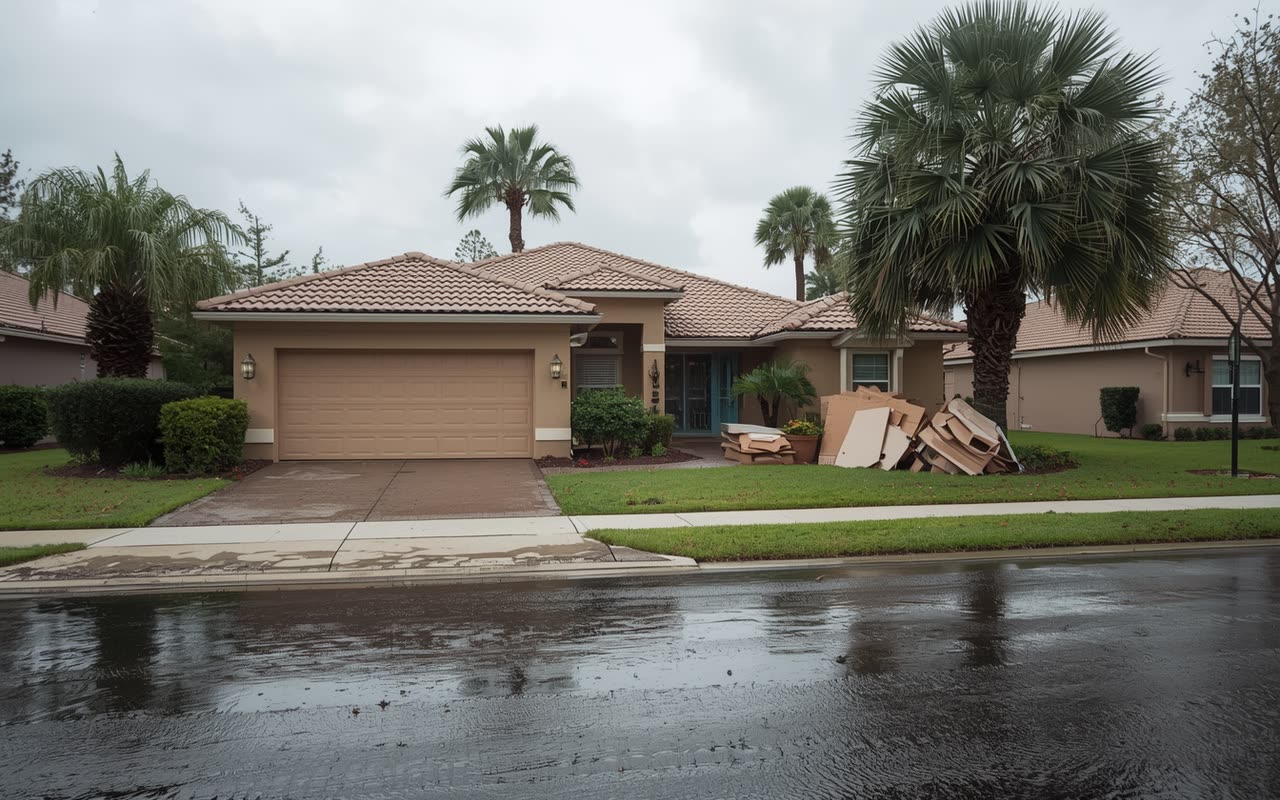
Flooding in a house is a different problem from a leak. A burst supply line puts water from a pipe into your rooms. A flood puts the street, the yard, the canal or the storm drain into your rooms, and everything those places carry comes along: soil, fuel, fertilizer, animal waste and, very often, sewage. That one fact changes what can be saved, what has to go in the dumpster and what protective gear anyone should wear while working in the house.
Tampa Bay has more ways to flood than most places. The bay is shallow, the land is low, and the area is cut by canals, bayous, retention ponds and two rivers that rise fast after heavy rain. The 2024 storms reminded a lot of people that a house can take water without ever being near the beach. This page explains how each kind of flooding behaves, why it matters for the plan for the work, and what a proper flood restoration job looks like from the first walk-through to the rebuild.
The four ways a Tampa Bay home floods
The source of the water decides how dirty it is, how long it stays, and what it does to the house, so it is worth knowing which one you had.
Storm surge. Surge is seawater pushed inland by a hurricane or strong tropical storm. In a shallow bay like Tampa Bay, wind can stack water up against the shoreline, and neighborhoods near the water, along the bayfront and around the canals can see it arrive in a rush and drain slowly. Surge water is salty and full of silt and debris. Salt matters: it corrodes electrical parts, copper lines and metal fasteners, and it holds moisture in building materials, so a surge house can feel damp long after the water is gone.
Heavy rain flooding. Tampa Bay summers deliver thunderstorms that drop several inches in a short time, and tropical systems drop far more. When storm drains and retention ponds cannot keep up, water collects in low streets, yards and driveways and rises to the door. Many yards slope toward the house, and a slab sits only a few inches above the ground, so a small rise outside can become an inch or two inside. This water is mostly rainwater mixed with whatever it ran across, which usually means lawn chemicals, soil and sometimes overflowing sewer or septic lines.
River flooding. The Alafia River and the Hillsborough River both drain large areas, and after a long rain or a tropical system they can rise over their banks and stay high for days. River floods are slower than surge, which gives some warning, but the water often lingers. Homes near these rivers can sit in water for a long stretch, which soaks structure deeper and gives mold more time to start.
Canal and bayou flooding. Canals, bayous and tidal creeks rise with the tide and with rain. A high tide plus a storm plus a clogged outlet can send canal water into streets and garages. This water is brackish, slow to leave, and very often contaminated by whatever the canal collects.
None of these is mild. If you are not sure which one you had, tell the specialist what you saw: how fast it came in, whether it was salty, whether it smelled like sewage, and how long it stayed.
Why floodwater is treated as Category 3
The industry standard for water damage, ANSI/IICRC S500, sorts water into three categories. Category 1 is water from a supply line, like a broken pipe or a failed ice maker hose. Category 2 is gray water with some contamination, like a washing machine overflow. Category 3 is grossly contaminated water that can cause serious illness: sewage, and water from rivers, canals and the ground. Floodwater is treated as Category 3 because it has been on the ground and in drains, and because you cannot see what is in it.
That classification is not fussiness. It sets the rules for the whole job:
- Porous materials that touched floodwater are generally removed, not dried. Drywall, insulation, carpet, pad and similar materials soak up contaminated water and cannot be made safe again by drying.
- Hard surfaces that survive are treated and dried, and the work is done with protective gear. Boots, gloves, eye protection and respirators are normal on a flood job.
- Time makes it worse. Category 3 water that sits warm for a day or two degrades toward a worse condition, and bacteria multiply in Florida heat.
- Contact is a health risk. Cuts and scrapes exposed to floodwater can become infected. The CDC has guidance on staying healthy after a flood, including washing hands carefully and keeping children and pets out of the water.
Safety before you go back in
Do not walk back into a flooded house just because the rain stopped. Check these first.
Is it safe to enter at all? Wait until local officials say your area is open. Roads may be washed out, and walls, floors and ceilings can be weakened. If you see a sagging ceiling, buckled floor, leaning wall or cracked foundation, stay out and have it looked at.
Electricity. Standing water and electricity are deadly together. If water reached outlets, the panel or appliances, do not enter a wet house with power on, do not touch the panel while standing in water, and do not flip breakers on to see what works. Have the utility or an electrician shut off power at the meter if you cannot do it safely from a dry spot. Never run a generator inside the house, the garage or the lanai. Carbon monoxide kills people after every Florida storm, and it does not take long.
Gas. If you smell gas, leave and call the gas company or 911 from outside.
Water. Do not drink or cook with tap water until local officials say it is safe. After a flood, boil notices are common.
Wildlife and debris. Snakes, rodents, fire ants and insects move into dry spots when water rises. Wear boots and gloves, and use a stick to move debris before you reach in.
Protective gear. Waterproof boots, rubber gloves, eye protection and an N95 respirator are the minimum for anyone handling wet materials. Children, pregnant women and anyone with asthma or a weak immune system should stay out of the house until the work is done.
What is safe to keep and what to discard
This is the question everyone asks, and the honest answer is that porous things that touched floodwater are usually not worth the risk. A rule of thumb many restoration crews use: if it soaks water up and you cannot wash it in hot water or fully dry and treat it, it goes.
Usually discard:
- Drywall and insulation. Floodwater wicks up drywall well above the waterline, and batt insulation holds contaminated water against the studs. Both are removed.
- Carpet and pad. Floodwater in carpet is a Category 3 problem. The pad is always discarded and the carpet generally is too.
- Mattresses, box springs and upholstered furniture. Foam and fabric hold contamination deep inside. These go.
- Food, medicine and cosmetics. Anything that touched floodwater, including canned goods with dents or damaged seals and anything in a refrigerator that lost power, should be thrown out. When in doubt, throw it out.
- Particleboard and pressed wood furniture. It swells and comes apart.
- Stuffed toys and pillows. Soft and porous, hard to make safe.
Sometimes salvageable:
- Solid wood doors, trim and cabinets. Solid wood can often be dried and treated, but the cabinets in many homes are particleboard under a veneer and do not survive. A technician should check them with a moisture meter. Doors that swelled and will not close are a sign they absorbed a lot of water.
- Hard, non-porous items. Glass, hard plastic, metal and sealed ceramic can usually be washed with soap and hot water and treated.
- Framing lumber. Structural wood is usually dried and kept, then checked with a moisture meter before it is closed in.
- Photographs and documents. Rinse gently and freeze them if you cannot dry them within a day or two, then ask a conservator or archive about next steps. Mold on paper spreads fast in Florida heat.
Separate items into "keep," "discard" and "unsure" piles, take photos of everything before it leaves the house, and do not throw away anything the insurance adjuster may need to see until you have documented it. More on that below.
Photographing and documenting
If you have flood insurance, or if you plan to file a claim of any kind, documentation is as important as the work itself.
- Photograph and video the water line. Take pictures of the water mark on every wall, high and low, with something for scale like a tape measure.
- Photograph every damaged item before moving it. Wide shots of each room, then close shots of contents.
- Make a written list. Item, age, rough value. This is tedious and worth it.
- Keep samples. Keep a small piece of carpet or flooring until the adjuster says it can go.
- Keep every receipt. Hotels, fuel, dumpsters, equipment rentals and supplies all count.
- Record dates and times. When the water came in, when it left, when you called who.
Do the documenting quickly, but do not delay safety or drying to do it. Mold does not pause for paperwork.
Flood cuts
A flood cut is a horizontal cut through the drywall, made at a line above the highest water mark, so the wet lower section can be removed. A proper flood cut goes well above the visible waterline, because moisture travels up drywall by wicking. A technician checks with a moisture meter and a thermal camera and cuts until the readings above the cut are dry.
On a flood job, flood cuts usually mean:
- Removing the wet drywall and baseboard, not just the part you can see.
- Pulling out the wet insulation behind it and discarding it.
- Opening the wall cavity so the studs and bottom plate can dry in the open.
- Checking the other side of any shared wall, since water goes through.
- Leaving the cavity open until readings match a dry reference, rather than closing it up early.
It looks drastic to see a wall opened to two feet or four feet, but it is the right call. Closing wet drywall back over a contaminated cavity is how a flood becomes a mold problem.
Drying a slab house after a flood
Most Tampa Bay homes sit on a concrete slab. When a flood comes in, the water does not drain down. It spreads across the floor, soaks into the bottom of walls and into every material touching the slab. That makes a slab house easy to flood and slow to dry.
A proper structural drying job follows the industry standard, which sets drying goals against a dry reference reading taken from an unaffected part of the house. It generally includes:
- Extraction. Standing water comes out first with pumps and extractors. The more water removed as liquid, the less the equipment has to evaporate.
- Removal of wet porous materials. Carpet, pad, baseboards, wet drywall and insulation come out so air can reach the structure.
- Air movers and dehumidifiers. Fans move air across wet surfaces and dehumidifiers pull the moisture out of the air. In Florida the outdoor air is wet too, so opening windows rarely helps. The house is closed up and dehumidified.
- Daily monitoring. Moisture readings are taken in the same places every day, and equipment is moved as the readings change.
- Treatment of the structure. Framing and slab-level surfaces that touched Category 3 water are treated before the building is closed back up.
- Final readings. Drying is finished when readings match the dry reference, not when the room feels dry.
If you want to learn more about the general process, see our pages on water damage restoration and emergency water removal. Flooded concrete itself is sturdy, but the materials in contact with it are not. Wood flooring can cup, laminate can swell, and tile can pop when the setting bed below stays wet.
Mold after a flood, and how fast it moves in Florida heat
Warm, wet materials grow mold in about 24 to 48 hours, and a flooded Tampa Bay house in summer is about as good a mold incubator as you can build. Outdoor humidity is high, the AC may be off without power, and the walls are wet. By day three, you may see fuzzy spots on baseboards, drywall and the backs of furniture. By day seven, the growth can be widespread and the house will smell musty.
That timeline is why the sequence matters: get water out, remove what cannot be saved, dry the structure and bring down the humidity. For the day-by-day plan, read our guide on mold after a hurricane or flood. If mold already shows, see mold removal. A small patch of about 10 square feet or less on a hard surface can often be handled by the homeowner, with an N95 respirator, gloves and eye protection. A flood is rarely a small patch.
Flood insurance basics
This catches many people by surprise: standard homeowner policies generally do not cover flood. Flood insurance is a separate policy, and it is worth understanding before a storm, not after.
- Where it comes from. The National Flood Insurance Program (NFIP), run by FEMA, sells flood policies through agents. Private flood insurance is also available from some carriers.
- The waiting period. NFIP policies generally have a 30-day waiting period before they take effect. You cannot buy coverage when a storm is already in the Gulf. Ask your agent about exceptions, such as policies tied to a new mortgage.
- Flood zones. FEMA maps flood zones such as A, AE, VE and X. High-risk zones are generally those with an A or V in the name, and mortgage lenders often require flood insurance there. Zone X is lower risk, but lower risk is not no risk, and plenty of flooded homes sit outside the high-risk zones. You can ask your city or county for your home's zone.
- What is covered. Policies vary. Many cover the building and, separately, contents, with limits and conditions. Read your declarations page to see what you have.
- Wind and water are different. A hurricane can cause both. Rain that came through a damaged roof is typically a wind claim under your homeowner policy. Water that rose from the ground is a flood claim. The line between them can be argued, so photograph both and keep your notes clear about what came from where.
Call your insurer or agent early, ask how to file, and ask what they need from you before you throw anything away. A restoration company can document the damage and the drying, but a claim decision is between you and your insurer.
Substantial damage and what it can mean for rebuilding
Local floodplain rules in Florida can treat a repair as "substantial damage" when the cost reaches about 50 percent of the building's value. If that happens, the building may have to be brought up to current floodplain standards, which can mean raising the lowest floor or other changes. This varies, and it is not a call a restoration company makes. Ask your city or county building department how it works where you live, and whether your property falls under it. Do this early, before you start rebuilding, because it can change what you are allowed to do.
Debris and curbside pickup
After a major storm, cities and counties usually set special rules for storm debris: where it can go, how it must be separated, and when it will be collected. Typical rules separate vegetation, construction debris and household items like furniture and appliances, and some set dates or deadlines. Because these rules change from storm to storm and differ between Hillsborough, Pinellas and Pasco counties and their cities, check your county or city website or call the local solid waste office before you pile anything at the curb. Do not block storm drains or roadways, and keep piles away from power poles and meters.
For a big flood job, a roll-off dumpster is often easier than curbside piles, and the specialist can tell you how to separate wet materials from the rest.
Electrical and AC system risks
Floodwater and a house's systems do not mix, and some of the biggest costs come from skipping this step.
Electrical. Outlets, switches, wiring, the service panel and breakers that were underwater need to be checked by a qualified electrician before power is restored. Water and salt corrode connections, and a system that looks fine can fail or start a fire weeks later. Do not turn the power back on yourself.
AC system. The outdoor condenser, the air handler and any ductwork that took water may be damaged. Many Tampa Bay homes have the air handler in the garage or on a closet floor, right where water gathers. If the air handler or ducts were wet, they can carry contamination and mold through the whole house once the system turns on. Do not run the AC until a technician has checked the equipment and the ducts. Flex ducting that got wet is commonly replaced.
Appliances. Refrigerators, washers, dryers, water heaters and anything with motors or electronics that touched floodwater should be inspected or replaced by a qualified technician, not simply plugged back in.
Rebuilding
Restoration and rebuild are separate stages. First comes safe entry, extraction, removal, drying and treatment. Then comes the rebuild: new insulation, drywall, flooring, trim, paint and any systems work.
Rebuilding too early is the most common mistake. Closing walls over materials that are still damp traps moisture and invites mold behind fresh paint. A proper job closes walls only when moisture readings confirm the structure is dry, and the building department may need to approve permits and inspections before work closes up. Choose materials that tolerate moisture where you can: moisture-resistant drywall in lower sections, tile or sealed concrete instead of carpet on the ground floor, and raised electrical outlets where local rules allow.
Rebuild work may require permits, and the person doing electrical or plumbing repair generally has to be appropriately qualified under Florida's rules. Ask who is pulling the permit and who is responsible.
What a flood visit looks like
Expect the specialist to start with a walk-through: where the water came from, how long it sat, what it touched, and what the house is made of. They will take moisture readings and thermal images, ask about the electrical status, and explain what comes out and what stays. Then comes a written plan, extraction and removal, and equipment set-up. Costs depend on the size of the job, the category of water and the materials involved, so a number only comes after the specialist sees the house.
If you call, tell them: your address, where the water came from, how deep it got, how long it stayed, whether power is off, and whether you have photos. If your home has a pool, a septic tank, or a crawl space, mention it.
Questions people ask
Is floodwater really that dangerous to touch?
Yes, treat it as contaminated. Floodwater commonly carries sewage, bacteria, chemicals and debris. Skin contact with open cuts, and breathing in dust from dried flood residue, are health risks. Wear boots, gloves, eye protection and an N95 respirator, wash hands thoroughly, and keep kids and pets out.
How long do I have before mold starts?
In Florida heat, mold can start in about 24 to 48 hours on wet materials. That is why removal of wet porous materials and dehumidification should begin as soon as it is safe to enter. Waiting for the insurance adjuster before you start drying is a common and costly mistake. Document first, then start.
Can I keep my carpet if the flood only reached a few inches?
Usually not. Carpet and pad that touched Category 3 water are generally removed. The cost of replacing carpet is usually less than the cost of dealing with contamination and mold later.
Does my homeowner policy cover flood damage?
Standard homeowner policies generally do not. Flood insurance is a separate policy, through the NFIP or a private insurer, and NFIP policies generally have a 30-day waiting period. Read your policy and call your agent to find out what you have.
Do I have to remove drywall if it looks dry?
If it sat in floodwater or wicked it up, the cavity behind it may be wet and contaminated even if the surface looks fine. A moisture meter and thermal camera will tell the story. Flood cuts go above the visible waterline for this reason.
What is "substantial damage"?
It is a floodplain rule term: when repair costs reach a set share of the building's value, often about 50 percent, the building may have to meet current floodplain standards when rebuilt. Rules differ by city and county, so ask your local building department.
Can I use my AC after a flood?
Not until a technician has checked it. A wet air handler, outdoor unit or duct system can be damaged, can short out, and can spread contamination and mold through every room.